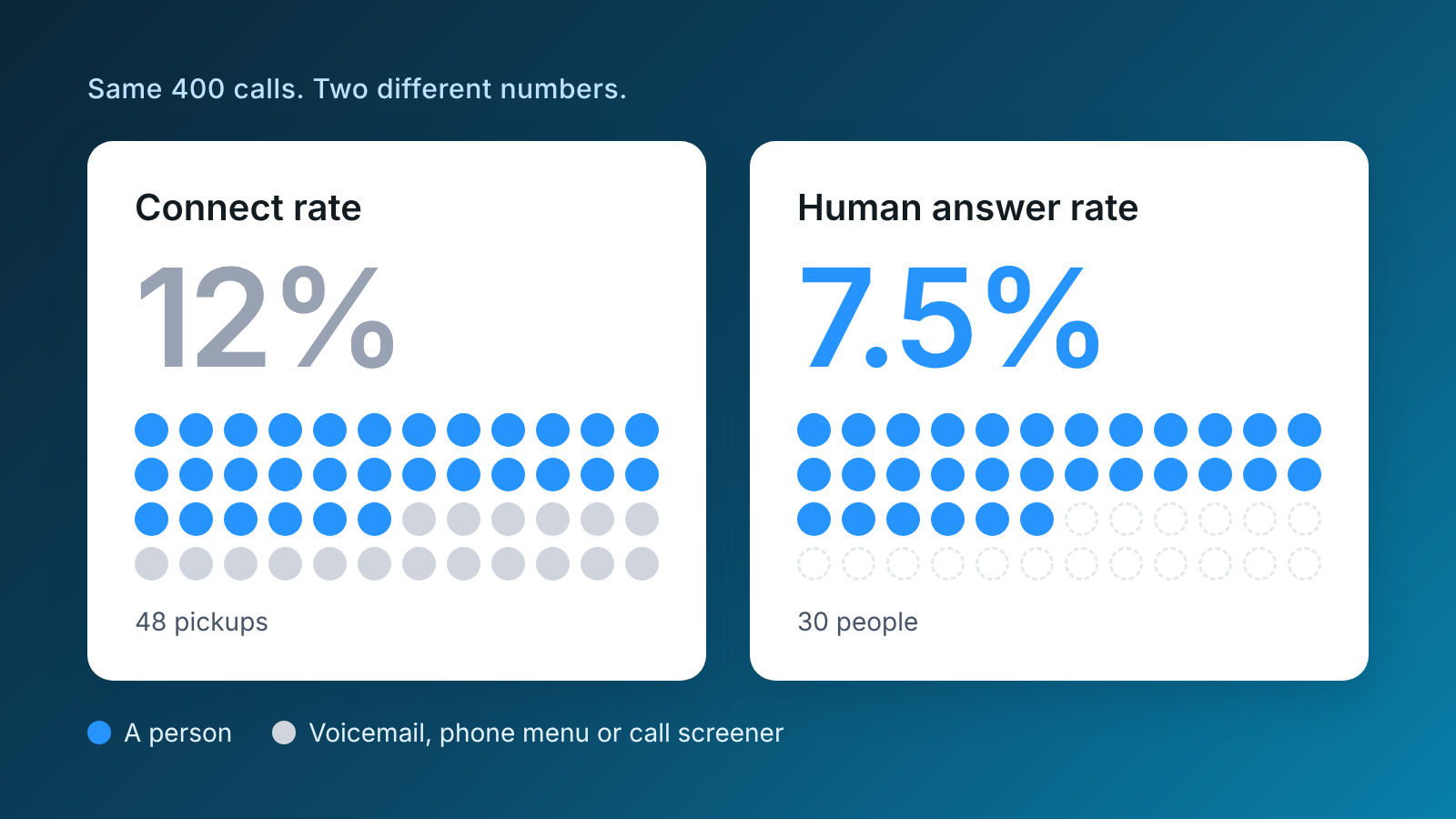
Two of your reps each make 400 calls this week. On your dialer, any pickup counts as a connection, so both of them finish the week with 48 connections and a 12% connect rate. On paper, they had the same week.
Rep A actually spoke to 30 people. Rep B spoke to 18, and the rest of Rep B's connections were voicemail, phone menus and call screeners. Work out their human answer rates, and Rep A is at 7.5% while Rep B is at 4.5%. If you coach on connect rate, you'd coach them exactly the same way.
What does connect rate actually measure?
There's no standard definition, so it depends on your dialer. On some dialers, any answered call is a connection, even if it was voicemail. On others, only a live conversation counts. On some, it has to be the exact person you were trying to reach.
So two teams can both say they have a 12% connect rate and mean completely different things.
How different call results count toward connect rate and human answer rate| What happened on the call | Counted as a connect? | Counted as a human answer? |
|---|
| You reached the person you called | Yes | Yes |
| You reached a receptionist or gatekeeper | On most dialers | Yes |
| You got voicemail | On some dialers | No |
| You got an automated phone menu | On some dialers | No |
| You got an iPhone or Google Voice call screener | On some dialers | No |
| You reached someone, but it was a wrong number | On some dialers | No |
What is human answer rate?
Human answer rate is the percentage of your outbound calls that a person answered. Anything that isn't a person doesn't count, however it's logged.
Human answer rate = calls answered by a person ÷ outbound calls × 100
For Rep A, that's 30 ÷ 400 × 100 = 7.5%. For Rep B, it's 18 ÷ 400 × 100 = 4.5%. Those are made-up numbers to show the math, not a benchmark.
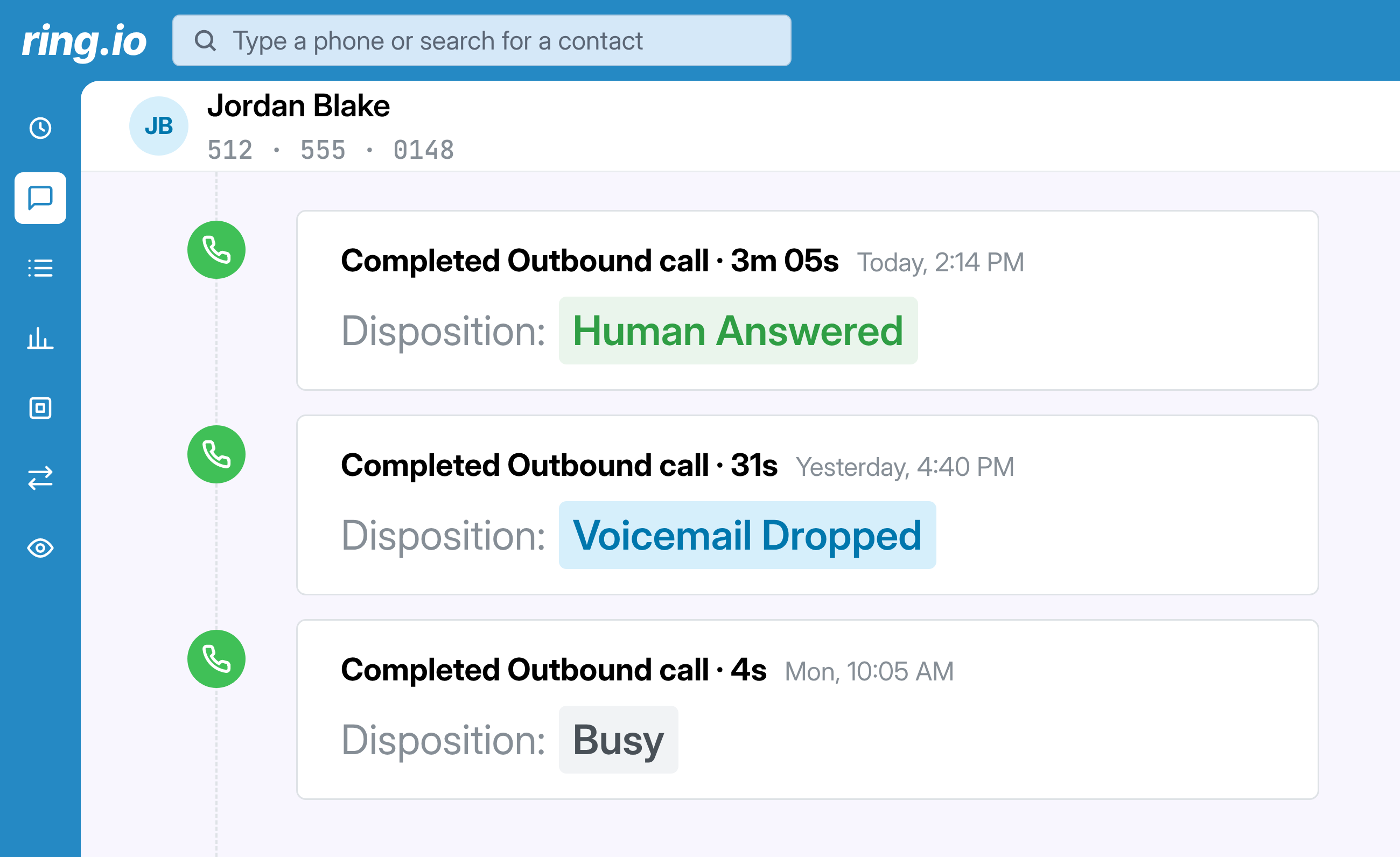
In Ring.io, human answer rate comes from call dispositions. On the Growth and Enterprise plans, Auto Disposition gives outbound calls a disposition automatically when they end. If your account requires reps to pick a disposition, they still choose the result on calls a person answered. Reps and managers can change any disposition that's wrong.
Only Human Answered counts toward human answer rate. Answered (picked up, but not by a person), Call screening, Voicemail Dropped, Voicemail Detected - No Drop, Busy, No Answer and Wrong Number are all left out.
Wrong Number might look odd on that list, since someone did pick up. But the number didn't belong to your contact, so it's a problem with your list rather than a human answer.
Connect rate vs. contact rate vs. right-party contact vs. human answer rate
People use these four terms as if they were interchangeable, but they're four different numbers.
Connect rate, contact rate, right-party contact and human answer rate compared| Metric | What's included | Watch out for |
|---|
| Connect rate | Calls marked as connected, by your dialer's definition | Voicemail and phone menus can be included, depending on the dialer |
| Contact rate | Calls that reached a contact. Some teams mean any pickup, others mean a person. | There's no shared definition, so agree on one |
| Right-party contact | Calls where you reached the exact person you were trying to reach | Someone has to confirm who picked up |
| Human answer rate | Calls a person answered | Gatekeepers count, even when they aren't your contact |
With human answer rate, machines are left out and nobody has to confirm who picked up, which makes it a fair way to compare reach across reps, phone numbers and dialers.
Why the gap keeps getting bigger
If voicemail counts as a connect on your dialer, your connect rate has always looked better than the number of people your team actually reached. Call screening and spam labels are making that gap bigger.
Call screening
Apple added call screening to the iPhone in iOS 26, released in September 2025. When it's turned on, calls from unknown numbers are answered automatically. The caller is asked for their name and why they're calling, and the person sees a transcript before deciding whether to pick up. Google Voice has a similar option for unknown callers.
Without call screening detection, a screened call gets handled like any other machine. It's logged as a connect, or a voicemail is dropped and your rep moves on. Either way, someone who was holding their phone never gets to talk to your rep.
Spam labels
Carriers score the phone numbers your team calls from. If one gets flagged, your calls show up as Spam Likely or Scam Likely, fewer people pick up, and nobody tells you.
Where voicemail counts as a connect, your connect rate might barely move, because the calls people ignore still go to voicemail. Your human answer rate drops, though. So when human answer rate falls and nothing else has changed, a flagged number is usually the first thing to check.
In Ring.io, you'll find every number you call from under Phone reputation in Call Analytics, with its label at AT&T, Verizon and T-Mobile and its own human answer rate. If a number is flagged, click Remediate and our team files with the carriers to get the wrong label removed. Caller ID spam monitoring and remediation are included on Growth and Enterprise.
How to measure human answer rate accurately
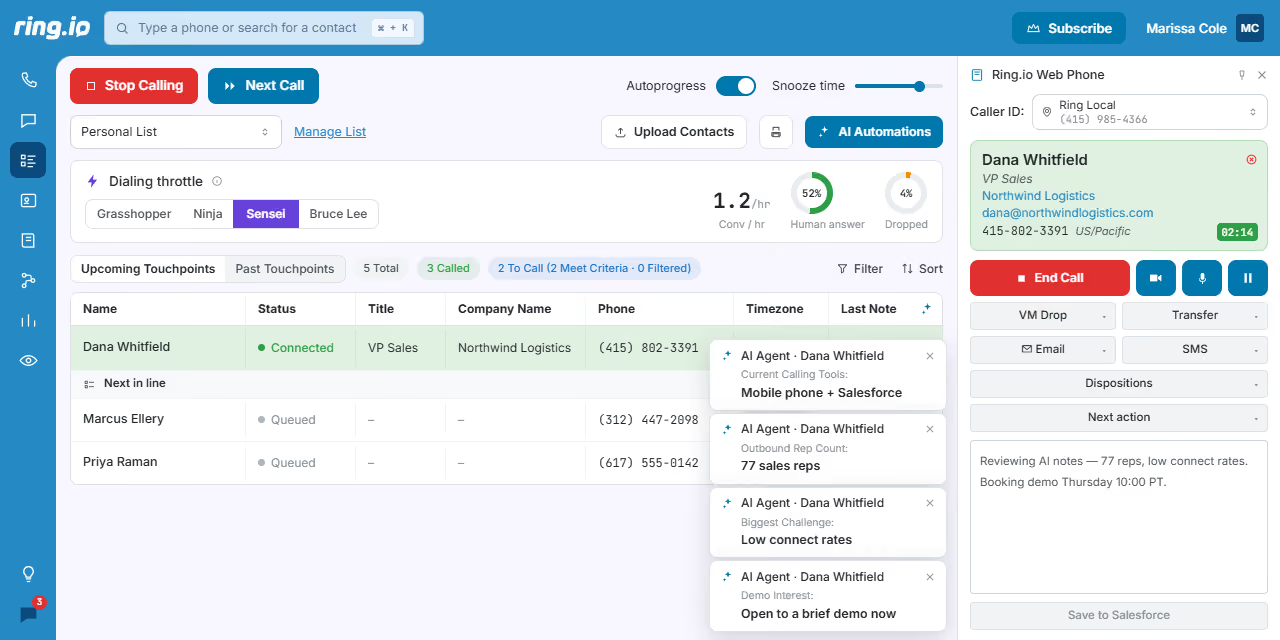
To measure it properly, you need to know whether each call was picked up by a person, a machine or a call screener. Reps can't keep track of that by hand across a few hundred dials a day. Things get missed.
Answering machine detection (AMD) is the usual way to tell people from machines, and it's based on the first few seconds of the call. A short "Hello?" and then a pause usually means a person. A long greeting with no pause usually means voicemail. Call screeners belong in their own group, because there's a person reading along on the other end.
On Growth and Enterprise, answering machine detection and Auto Disposition sort every answered call into one of those three groups. Call screening detection works on every plan.
No detection is perfect. Some voicemail greetings sound like a person, and some people answer the phone like a voicemail greeting, so reps and managers can change any disposition after the call. Call screening detection covers iPhone call screening and Google Voice. It doesn't detect other screeners, such as the ones built into some Android phones.
What is a good human answer rate?
We publish Ring.io's human answer rate on our stats page, updated daily over the last 30 days. On 20 November 2026, it was 13.5%. You can also see where Ring.io teams sit there, from the median to the top 25% and the top 10%.
Before you compare your number with a benchmark, ask three questions.
What happens after someone picks up
Once you know how many calls reached a person, the next question is what came out of those conversations.
With business outcome tracking, we use AI to analyze the transcript of every outbound call a person answered and tag your target outcome when it happens, like a meeting booked or a sale made. You set what that outcome is worth in dollars, and you see the total by rep, team, phone number and hour on the Business outcomes dashboard.
The same dashboard has your funnel in three numbers: calls made, calls a person answered and calls that ended in your outcome. Human answer rate is the one in the middle.
Now go back to Rep A and Rep B. Say Rep A booked 3 meetings from 30 conversations and Rep B booked 4 from 18. Rep B reached fewer people but booked more meetings, and you'd only see that in the outcome numbers.
What you won't see in human answer rate
Human answer rate is a measure of reach, so there are three things you'll need other numbers for.
Frequently asked questions
Does voicemail count as a connect?
On some dialers it does, because technically the line was answered. On others, only live conversations count. Voicemail never counts toward human answer rate.
What's a good connect rate for cold calling?
It depends on what counts as a connect on your dialer. A rate that includes voicemail and call screeners will always look higher than one that only includes people, so check how any benchmark was measured before you compare. We publish our own human answer rate every day on our stats page.
What's the difference between connect rate and contact rate?
Some teams use both terms for any call where someone or something picked up. Others only use contact rate when a person was reached. Neither has a standard definition, so check how each one is calculated on your dialer.
See what every human answer is worth
Getting a person on the line is only the start. With business outcome tracking, you can see which of those conversations turned into meetings and sales, and what each one was worth to your business. It's included on Growth and Enterprise, and you can try Growth free for 21 days.
See how business outcome tracking works